
Many Indian shops start with a phone ledger app to track udhaar. It is simple, free and familiar. The search for a khatabook alternative for shops usually begins when the owner realises the ledger knows who owes money, but not what was sold, what tax applied or what stock is left. This guide uses Caddayn Biller as one evaluation example, without invented feature claims or competitor pricing.
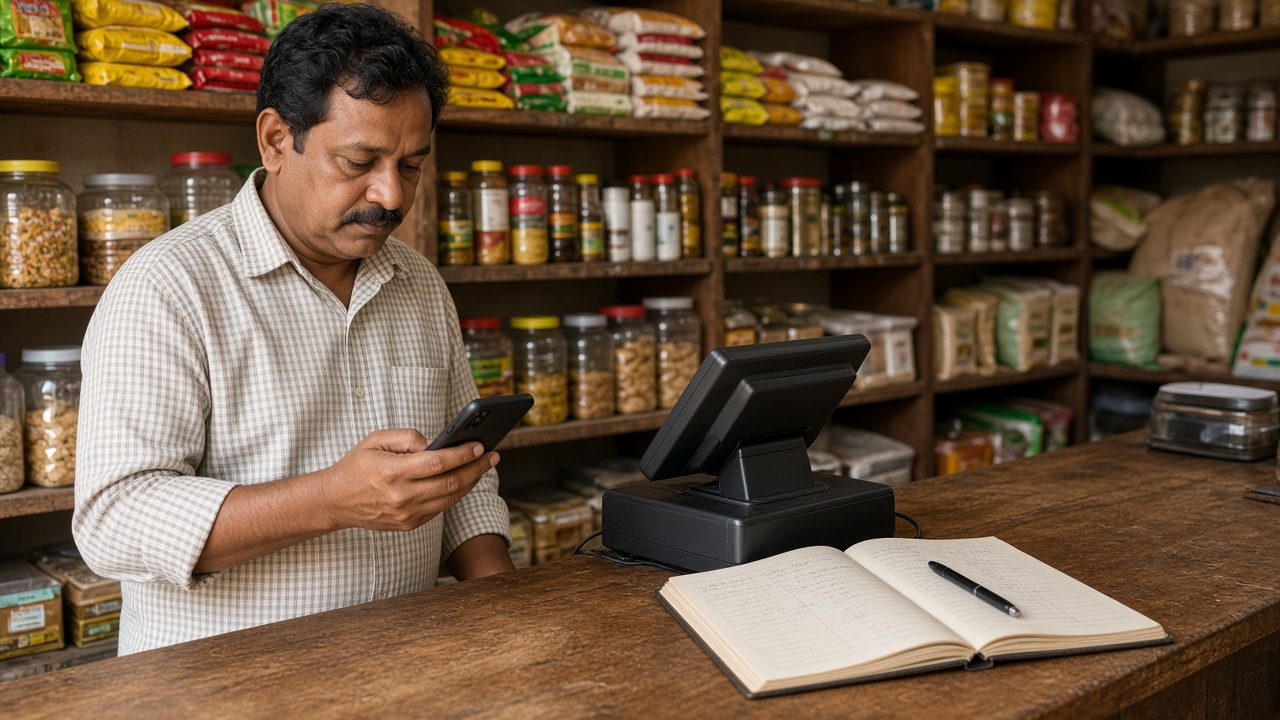
What “khatabook alternative for shops” means for Indian shops
Ledger apps solve one job well: remembering customer credit. A growing shop needs that job connected to billing, GST invoices, stock and day-end cash. When those live in separate places, the owner reconciles them by hand every week.
In practice, shops need:
- Credit sales recorded on the same invoice that reduces stock
- Customer dues that update automatically when a bill is raised or paid
- GST invoices instead of plain amount entries
- Collection reminders tied to the actual bill
- Partial payments by cash or UPI
- Reports that show both sales and outstanding dues
Related reading: udhaar / credit ledger billing, customer dues management, kirana billing software, billing software for small business, UPI payment billing software. To judge how much system you need, see billing app vs retail ERP.
Checklist to score in demos
| Capability | Why it matters | Pass signal |
|---|---|---|
| Credit on invoice | One record, not two | Credit bill updates dues and stock together |
| Dues ledger | Collection discipline | Outstanding per customer is visible instantly |
| GST billing | Compliance | Tax invoice prints correctly for your items |
| Stock link | Shrink control | Sale reduces quantity immediately |
| Roles | Trust | Helpers cannot edit dues silently |
Score every vendor with the same checklist and your own data. Use retail software demo checklist to structure a 20-minute session and mistakes when choosing retail POS to avoid common selection traps.
Moving from a ledger app without losing customer balances
- Export or list every customer with current outstanding
- Agree balances with major customers before cutover
- Load customers and opening dues into the new software
- Start billing credit sales only in the new system
- Stop entering new udhaar in the old app from day one
- Keep the old app read-only for reference for a few months
Write the process down before configuring software. Tools enforce a process; they do not invent one.
Ledger app vs GST POS: what actually changes
A ledger app records “Ravi owes ₹2,400.” A billing system records the invoice behind that number: items, tax, date, cashier. When a dispute comes, the invoice settles it. When filing comes, the same invoices feed GST reports. When stock runs low, the same sales drive reorder decisions.
That is why owners outgrow ledger apps. Read udhaar / credit ledger billing, customer dues management and pay-later billing software for credit workflows, and billing app vs retail ERP to judge how much system you need.
Mistakes to avoid
- Migrating without agreeing balances with customers
- Running both apps in parallel for months
- Ignoring GST because “customers never ask for invoices”
- Letting every helper edit customer balances
- Choosing software that cannot handle partial payments
For cost framing see retail billing software price in India; for payback see ROI of retail POS.
Where Caddayn Biller fits
Caddayn Biller is cloud GST billing and retail ERP software with POS, inventory, purchases, quotations, GST-oriented reports and multi-user patterns. Whether it fits your khatabook alternative for shops needs depends on demo evidence. Bring real items, a typical customer case and your CA’s report list when you request a demo. Product pages: retail billing & ERP, supermarket billing software. Guide index: retail POS & GST guides index.
Frequently asked questions
Can I keep using a ledger app alongside billing software?
You can, but double entry causes mismatches. Pick one system of record for dues.
Is a KhataBook alternative only for large shops?
No. Small kirana and hardware shops switch once credit, GST and stock need to agree.
Will customers notice the change?
Mostly through proper invoices and clearer reminders, which usually builds trust.
What should I bring to a software demo?
Your top SKUs, a sample purchase bill, one credit or return case, printer and scanner details, and the export list your CA uses.
How long does a typical rollout take?
Small shops often go live within a week or two; data cleanup usually takes longer than training.
Practical rollout notes for khatabook alternative for shops
Teams researching khatabook alternative for shops often underestimate the non-software work that decides success. Budget time for item-master cleanup, cashier rehearsals and a quiet go-live window. Create a shared checklist that covers printers, scanners, network failover and who approves discounts after launch. Review the first fifty invoices with your CA or internal reviewer to catch tax-master mistakes early. Document exception paths—power cuts, network drops, rush-hour overrides—so staff do not invent risky shortcuts.
Use internal references while you execute: mistakes when choosing retail POS for selection traps, retail billing software price in India for TCO framing, GST billing for retail shops and GST reports for retail shops for GST process context, inventory management with POS for stock discipline, offline vs cloud POS for connectivity planning, and retail POS & GST guides index for the wider guide cluster. If credit sales are part of your model, align dues policy with udhaar / credit ledger billing and customer dues management. If you are expanding footprint, read second-store software checklist, multi-outlet POS software and multi-branch retail billing before configuring users. Small shops can stay lean with kirana billing software and billing software for small business guidance without buying complexity they will not use this year.
Schedule a thirty-day post-launch review. Measure queue-time samples, stock variance on top SKUs, role violations and how long filing prep takes versus the previous month. If those metrics do not improve, fix process ownership before buying another module. That is how content about khatabook alternative for shops becomes operational improvement instead of another unread bookmark.
Conclusion
Getting khatabook alternative for shops right is about matching software to your real workflow, proving it with your own data, and keeping one system of record so stock, tax and money all agree.
When you are ready to evaluate a Kerala-rooted retail platform, explore Caddayn Biller, retail billing & ERP, or request a demo with your SKU count, daily bill volume, staff roles and branch plan. Insist on a demo that uses your items—not only a sample catalogue—so you can judge counter speed, stock truth and GST reports under realistic conditions. Use retail software demo checklist as your scorecard.