
Customer dues management for retail is the difference between controlled credit and a drawer of disputed notebooks. Moving from paper khata to system balances only works if opening dues are trusted and billing stays the single source of truth. This guide covers migration steps, weekly habits and software checks for Indian retail shops.
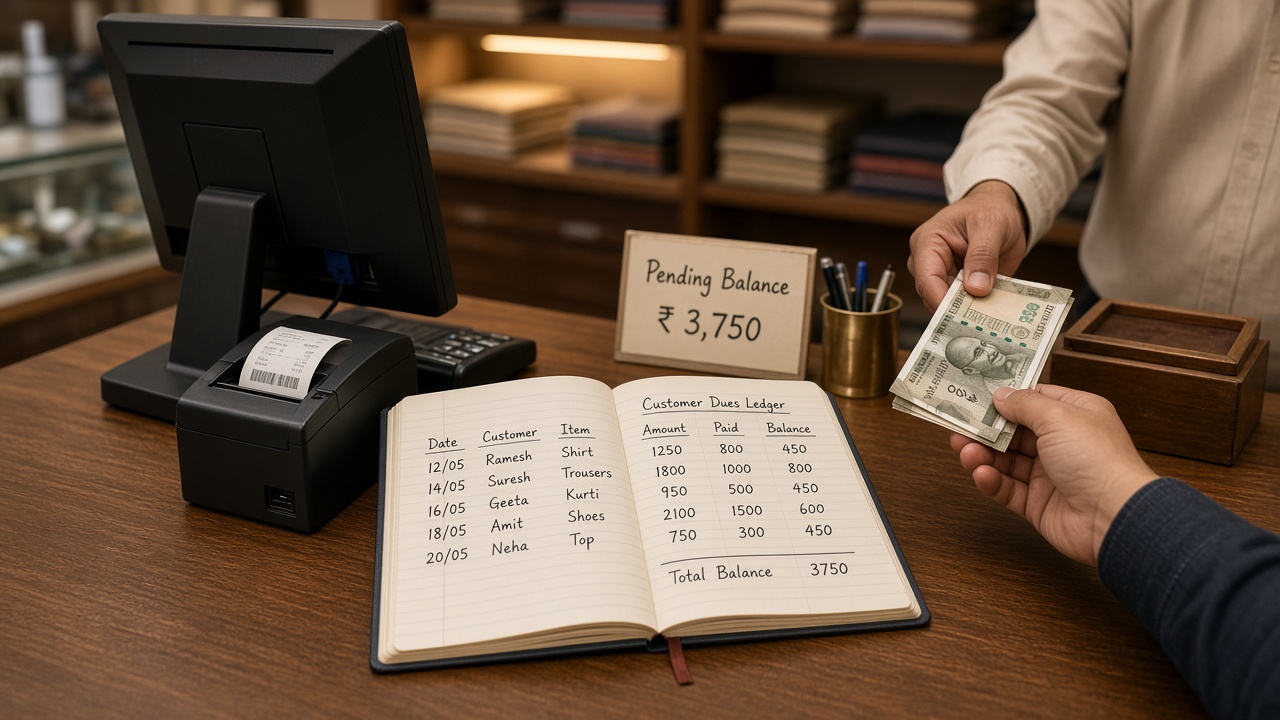
Why paper khata collapses as you grow
- Handwriting and memory disputes with regulars
- Staff changes erase context
- Collections are not tied to invoice IDs
- GST bills and dues stories diverge
- Owners discover true exposure only when cash is tight
Credit-ledger software requirements are covered in udhaar / credit ledger billing. If you are still choosing basic billing tools, see kirana billing software and billing software for small business.
Migration playbook from notebooks to software
- Pick a firm cut-off date
- List customer-wise opening dues; get acknowledgement where possible
- Enter openings into software carefully (dual review helps)
- Stop writing new dues in notebooks the same day
- Train collection receipts / settlement screens
- Review ageing every week for at least 60 days
- Escalate chronic overdue accounts with a written policy
Do not run parallel khata “for safety.” Parallel ledgers recreate the problem you are trying to escape.
Operating rules that keep dues clean
- Only named roles can approve credit sales
- Every credit sale still produces a proper invoice where applicable
- Partial collections always reference the customer account
- Weekly ageing review beats month-end shock
- Credit limits exist for risky accounts—even soft limits help
Permission discipline matters as much as screens. GST hygiene still applies—GST billing for retail shops. Avoid outside-system “adjustments” that break audit trails.
Software capability checklist
| Capability | Why it matters |
|---|---|
| Customer outstanding view | Instant answer at the counter |
| Pay-later on bill | No dual entry into a second app |
| Settlement history | Ends “I already paid” fights |
| Credit limit controls | Prevents silent over-exposure |
| Ageing reports | Owner sees risk, not only cashiers |
| Role limits | Not everyone can grant credit |
Evaluate these inside one billing system where possible. Bolting a separate khata app onto POS usually reintroduces double entry.
Metrics and governance
Track:
- Total dues vs monthly sales
- Dues older than 30/60/90 days
- Number of credit approvals by user
- Collection conversion after weekly reviews
If dues climb while sales are flat, tighten limits before festival credit spikes. Multi-store teams must review per branch—multi-outlet POS software, second-store software checklist.
Caddayn fit
Pay-later / pending customer payment tracking is documented for Caddayn Biller. In request a demo demos, prove: create credit sale → collect partial payment → show outstanding. Retail product: retail billing & ERP. Related reading: retail POS & GST guides index, mistakes when choosing retail POS, retail billing software price in India, billing app vs retail ERP.
Frequently asked questions
What if customers dispute old notebook balances?
Carry signed opening statements where you can; freeze the cut-off firmly.
Can I keep WhatsApp as the dues ledger?
Poorly. Chat is not an audit trail for collections.
Is dues management only for kirana?
No—hardware, wholesale and regulars across retail use credit.
Should credit sales skip GST invoices?
Risky. Prefer credit sales that still produce proper invoices where applicable; confirm with your CA.
How often should I review ageing?
Weekly is a good default for active credit shops.
What is the first software test in a demo?
Credit sale + partial collection + outstanding view in one flow.
Extra operating guidance for customer dues management retail
Teams researching customer dues management retail often underestimate the non-software work that decides success. Budget time for master-data cleanup, cashier rehearsals and a quiet go-live window. Create a shared checklist that covers printers, scanners, network failover and who approves discounts after launch. Review the first 50 invoices with your CA or internal reviewer to catch tax-master mistakes early. Document exception paths—power cuts, network drops, rush-hour overrides—so staff do not invent risky shortcuts. These habits matter as much as feature matrices when you compare Caddayn Biller or any other shortlisted system.
Use internal references while you execute: mistakes when choosing retail POS for selection traps, retail billing software price in India for TCO, GST billing for retail shops for GST process context, inventory management with POS for stock discipline, offline vs cloud POS for connectivity planning, and retail POS & GST guides index for the wider guide cluster. If credit sales are part of your model, align dues policy with udhaar / credit ledger billing. If you are expanding footprint, read second-store software checklist and multi-outlet POS software before configuring users. Small shops can still stay lean by following kirana billing software and billing software for small business guidance without buying complexity they will not use this year.
Finally, schedule a 30-day post-launch review. Measure queue time samples, stock variance on top SKUs, number of role violations and how long filing prep takes versus the previous month. If those metrics do not improve, fix process ownership before buying another module. That is how content about customer dues management retail becomes operational improvement instead of another unread bookmark.
Conclusion
Succeed at customer dues management by killing parallel khata, limiting who can grant credit, and reviewing ageing weekly—not by buying software alone.
When you are ready to evaluate a Kerala-rooted retail platform, explore Caddayn Biller, retail billing & ERP, or request a demo with your SKU count, daily bill volume, staff roles and branch plan. Insist on a demo that uses your items—not only a sample catalogue—so you can judge counter speed, stock truth and GST reports under realistic conditions.