
Shops rarely lose money on retail POS because the licence looks expensive on day one. They lose money when queues stay slow, stock stays wrong and owners still rebuild Excel every Sunday. Measuring the ROI of retail POS software in India means tracking where cash and hours come back—not admiring a dashboard screenshot.

This guide maps the recovery levers Indian retailers actually feel, a simple ROI worksheet you can fill with your numbers, and how to avoid fake payback math. Pair it with retail billing software price (TCO) so cost and benefit use the same 12–24 month window.
ROI in plain language
A practical shop formula:
ROI % ≈ (Annual benefit − Annual POS cost) ÷ Annual POS cost × 100
Payback months ≈ (Year-one POS cost including setup/hardware share) ÷ (Monthly benefit)
“Benefit” is not hope. It is rupees or hours you can defend: fewer stock losses, fewer stock-outs, less overtime on day-end, fewer billing mistakes, less CA prep chaos. If you cannot name the lever, do not put it in the spreadsheet.
Where Indian shops typically recover cost
1. Checkout speed and queue recovery
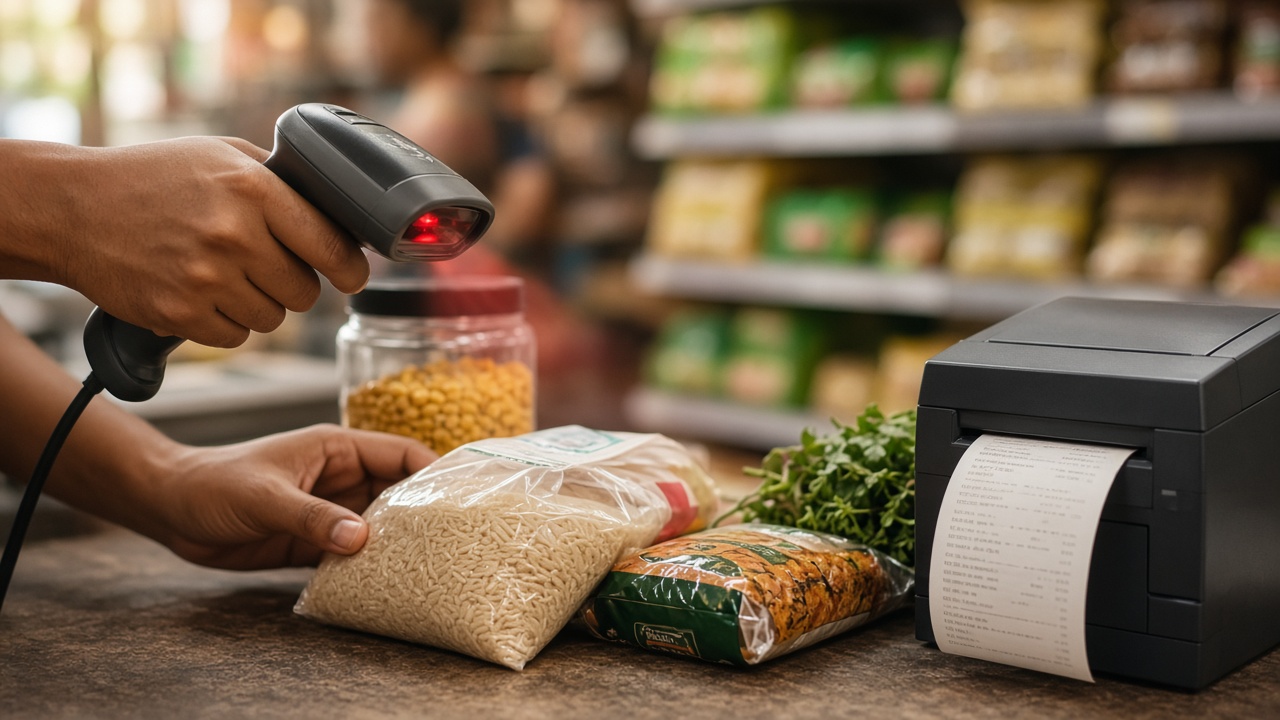
Manual or slow digital billing burns peak-hour capacity. Industry explainers targeting Indian retail often contrast multi-minute manual invoices with sub-minute POS billing once barcodes and GST slabs are set. You do not need a vendor case study to estimate your own version:
- Seconds saved per bill × bills per day × working days × value of counter time (or lost impulse sales from long queues)
Even conservative seconds add up when you cross dozens of bills daily. If you are still on a thin billing app, see when depth matters in billing app vs retail ERP.
2. Stock accuracy and shrinkage control

When sales do not deduct stock automatically, shrinkage hides inside “miscellaneous.” POS-linked inventory recovers cost by:
- Catching theft/process gaps earlier through variance reviews
- Reducing write-offs from expiry/dead stock when alerts exist
- Stopping purchase guesses that overstock slow movers
Public case studies from POS vendors report material drops in discrepancies after real-time inventory—treat those as directionally useful, then measure your variance for 4–8 weeks. Deepen the ops angle with inventory management synced with POS.
3. Fewer stock-outs on sellers
Empty shelves on fast movers cost more than software fees. Low-stock alerts tied to live sales help you reorder before the weekend rush. Benefit ≈ margin on recovered units you can honestly say were lost before.
4. Staff control and discount leakage
Unrestricted price overrides are a quiet margin drain. Role-based POS recovers cost when only managers can discount, delete bills or edit masters—and every exception leaves a trail.
5. GST and CA prep time
Owners often spend long windows assembling sales and tax views before filing. Cleaner GST-oriented sales reports compress that labour. Validate invoice and return concepts against gst.gov.in and your CA; software accelerates preparation—it does not replace compliance judgement. Related reading: GST billing software for retail shops.
6. Multi-outlet visibility

Excel merges across branches burn owner evenings and hide transfer errors. Multi-outlet POS/ERP recovers cost as shared catalogues, branch stock and consolidated sales replace manual stitching. See multi-outlet POS software and broader ops depth in retail ERP software.
7. Offline resilience in peak season
A billing freeze during a network cut forces handwritten slips and night re-entry—double work and error risk. Offline-capable POS protects festival revenue and owner sleep. Compare options in offline POS vs cloud POS.
A shop-floor ROI worksheet (use your numbers)
| Recovery lever | How to estimate monthly ₹ | Your note |
|---|---|---|
| Checkout time | (Minutes saved/day ÷ 60) × hourly counter cost × days | |
| Shrink / variance | Expected reduction in monthly write-off or unexplained gap | |
| Stock-out recovery | Extra units sold × margin on top sellers | |
| Discount leakage | Estimated unauthorised discount ₹ stopped | |
| Admin / CA prep | Hours saved × realistic hourly cost | |
| Multi-store consolidation | Owner/manager hours saved on merges × rate |
Sum honest monthly benefits. Divide year-one TCO by that monthly figure for payback months. Revisit after 60 days with actuals—not the sales demo’s promises.
What not to count as ROI
- Vanity dashboards you never open
- Features for another vertical (restaurant KOT in a garment shop)
- “Industry average 300% ROI” claims without your baseline
- Hardware you already needed for any serious billing—allocate fairly, do not double-count miracles
Also avoid selection mistakes that destroy ROI before go-live: sample-only demos, dirty masters, no roles. Use 12 mistakes when choosing retail POS as a pre-buy filter. If you are leaving accounting-first tools, align timing with when to switch from Tally and evaluation help in Tally alternative for retail.
Illustrative payback scenarios (not promises)
These are teaching examples—replace with your arithmetic:
- Single busy counter — Recovers mainly via billing speed + stock deduction; payback often discussed by Indian retail guides in a matter of months when bill volume is material and masters are clean.
- Shrink-heavy category shop — Inventory discipline and overrides dominate benefit; software fee is secondary to variance reduction.
- Second store launch — Consolidation and transfer accuracy dominate; lightweight apps usually fail the ROI test here even if stickers look cheap.
Vendor case studies sometimes publish large shrinkage or revenue lifts; useful as inspiration, weak as your business plan. Your 60-day variance log beats their homepage.
How to improve ROI after you buy
- Clean barcodes and GST rates in week one
- Enforce cashier roles immediately
- Review exception reports (deletes, discounts, stock adjustments) weekly
- Count stock on a cadence and reconcile—software cannot replace the count
- Agree CA exports before the first filing cycle ends
Process is half the return. The other half is choosing software that actually links bills to stock and reports you will use.
How Caddayn supports an ROI-minded rollout
Caddayn builds retail shop billing and ERP software for Indian retail operations. Capabilities relevant to recovery levers include barcode POS with GST calculation, real-time inventory and low-stock alerts, purchase/supplier tracking, customer history, sales reports, multi-branch reporting patterns and offline POS/billing support described across Caddayn retail materials.
Review Caddayn Biller, then book a demo with your worksheet: daily bills, top SKU stock-outs, shrink concerns, branch plan and CA report needs. Ask to stress-test the levers you intend to monetise—not a generic tour.
FAQ
What is a good ROI for retail POS software in India?
One that pays back inside a planning horizon you can survive—often within the first year for busy counters—using conservative benefits. “Good” is your payback date, not a viral percentage.
How long before POS software pays for itself?
It depends on bill volume, stock pain and how cleanly you implement. Shops that only replace paper without fixing masters see slow ROI; shops that fix queues and stock usually see faster payback.
Does ROI include hardware?
Yes in year-one TCO if you bought devices for the project. If you reused a stable PC, include only new printers/scanners.
Can a cheap billing app have better ROI than retail ERP?
Yes for tiny simple shops. No when branches, shrink and purchase complexity make cheap tools expensive in labour—compare scopes in the billing app vs ERP guide linked above.
How do I prove ROI to a partner or CA?
Baseline 2–4 weeks of queue time samples, stock variance and admin hours before go-live; repeat after 60 days; show the delta next to TCO.
Conclusion
The ROI of retail POS software in India shows up in recovered counter time, tighter stock, fewer silent discounts, faster GST prep and calmer multi-store control. Build the worksheet with humble numbers, buy for the levers you will operate weekly, and re-measure after two months. To explore those levers on a retail-focused stack, see Caddayn’s retail billing and ERP page or start a conversation with your ROI notes in hand.