
If you run a shop, a small restaurant or a trading business, you have probably asked a simple question at least once: what exactly should I write down, and how often? This guide explains how to maintain accounts for small business in India in plain steps. It covers the few books you really need, a daily, weekly and monthly routine you can follow without an accountant sitting next to you, and the points where it makes sense to bring in your CA.
The aim is not to turn you into a bookkeeper. The aim is to make sure that at any moment you can answer four questions: how much did I sell, how much did I buy, what do I owe and who owes me.
Why proper accounts matter for a small business
Many small business owners keep accounts only because the GST return or the income-tax return asks for numbers. That is the least useful reason. Clean books help you in everyday decisions:
- Cash control: you know if the cash in the drawer matches the sales of the day, and you catch shortages early.
- Credit control: you know which customers are overdue and which suppliers must be paid this week.
- Profit clarity: you see whether the business is actually making money after rent, salaries and electricity, not just whether sales are high.
- Loans and tenders: banks and large buyers ask for statements. Books that are kept up to date make that a one-day job instead of a one-month panic.
- Compliance: GST law requires registered businesses to keep accounts and records at their principal place of business and to preserve them for a long period (72 months from the due date of the annual return, under Section 36 of the CGST Act). Income-tax law also expects proper books once your income or turnover crosses certain limits.
The minimum books every small business should keep
You do not need a dozen registers. For most shops and small traders, these six records cover almost everything.
1. Cash book
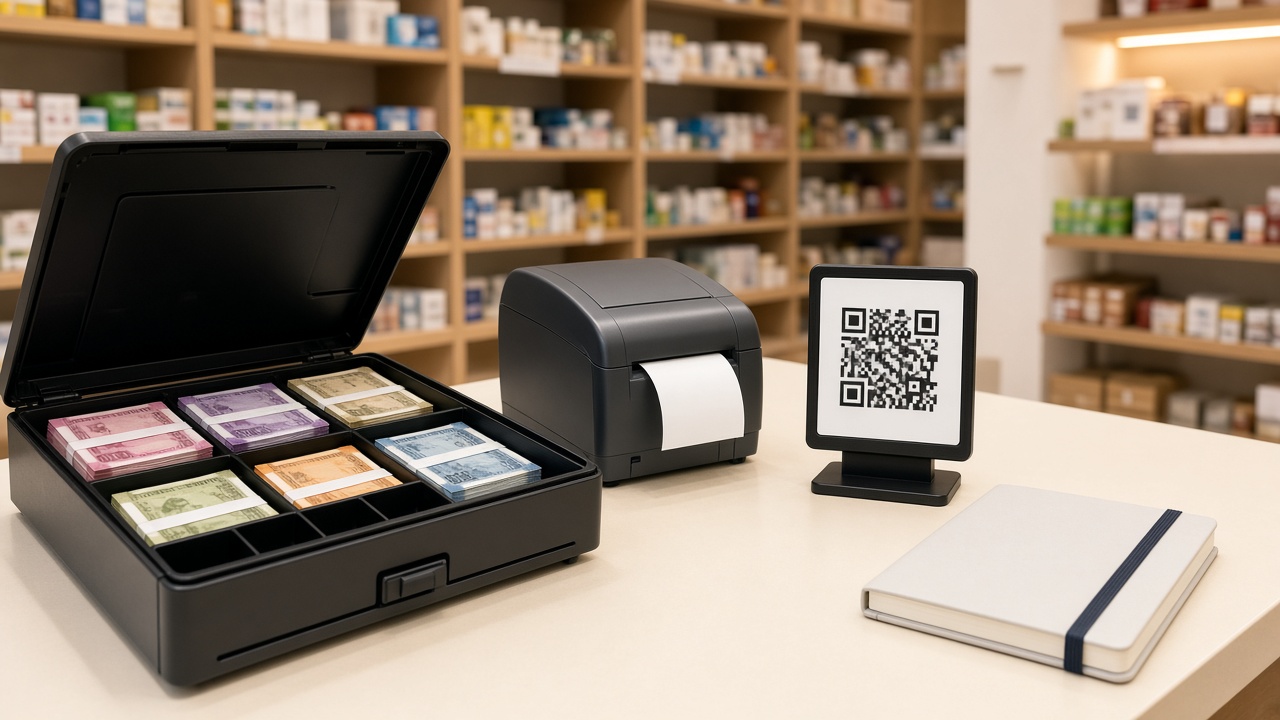
The cash book records every rupee that comes in and goes out in cash: cash sales, cash paid to suppliers, petty expenses, owner withdrawals and money deposited into the bank. At the end of each day, the closing balance in the cash book should match the cash physically in the drawer and safe.
2. Bank book
Treat your bank account like a second cash book. Record UPI receipts, card settlements, cheques, NEFT payments and bank charges. Once a month, compare it with the bank statement. This is called bank reconciliation, and it catches missed entries, duplicate payments and charges you did not expect.
3. Sales register
Every sale needs a bill. If you are GST registered, your tax invoice must carry the details the GST rules require, such as your GSTIN, invoice number, date, HSN code, taxable value and tax. The sales register is simply the list of all bills, split into cash and credit sales. A billing software produces it automatically; in a manual system it is a bill book plus a daily summary.
4. Purchase register
Record each supplier bill with the supplier name, GSTIN, bill number, date, taxable value and GST. Keep the original bills filed month-wise. If you claim input tax credit, the purchase register is what you will match against the supplier data that appears in your GST portal.
5. Expense register
Rent, salaries, electricity, transport, packing material, repairs and internet are business expenses. Write each one down with a voucher or a bill. Small cash expenses without a bill should still get a signed petty cash voucher, because unexplained expenses are the first thing a CA or tax officer will question.
6. Debtors and creditors ledger
Keep one page (or one ledger account) for each customer who buys on credit and each supplier you buy from on credit. Each sale, payment and return goes into that party’s account, so the balance always shows who owes what. Our guide on managing customer dues in retail covers how to keep credit customers under control.
Along with these, keep a simple stock record. Even if you do not track every item, you should know your opening stock, purchases, sales and closing stock value for the month, because profit cannot be calculated without it.
How to maintain accounts for small business in India: a daily, weekly and monthly routine
Books fall apart when entries pile up. A routine fixes that. Here is a schedule that fits a busy shop.
Every day (15 to 20 minutes at closing)
- Print or note the day’s sales summary, split by cash, UPI, card and credit.
- Count the cash and match it with the cash book. Write down the reason for any difference the same day.
- Enter every cash expense with its voucher or bill.
- Enter purchase bills received that day, or at least put them in a “to be entered” tray.
- Note any credit sale or customer payment in that customer’s account.
Every week
- Enter any pending purchase bills and check them against the goods received.
- Review the list of customers who are overdue and follow up.
- Check which supplier payments fall due next week and plan cash for them.
- Deposit surplus cash into the bank instead of keeping a large amount in the shop.
Every month
- Reconcile the bank book with the bank statement.
- Match your purchase register with the supplier invoices shown on the GST portal before filing returns.
- Share the sales and purchase registers with your CA or tax consultant in time for GST filing.
- Take the closing stock value, at least for high-value items.
- Prepare a simple monthly profit and loss statement. Our guide to the profit and loss statement for a small shop shows the format.
A worked example: a small stationery shop in Thrissur
The figures below are made up to show the method; they are not real data.
Suppose a stationery shop in Thrissur closes the day with the following:
- Total sales from bills: ₹18,400 (cash ₹7,900, UPI ₹8,300, credit to a nearby school ₹2,200)
- Opening cash in the drawer: ₹3,000
- Cash expenses: tea and snacks ₹180, courier ₹120
- Cash paid to a supplier against a bill: ₹4,000
Expected closing cash is ₹3,000 + ₹7,900 − ₹180 − ₹120 − ₹4,000 = ₹6,600. If the drawer has ₹6,450, there is a shortage of ₹150. The owner writes this down at once and checks the day’s bills and change given. Waiting a week would make the cause impossible to trace.
The ₹8,300 UPI goes to the bank book, and the ₹2,200 credit sale goes to the school’s account in the debtors ledger. At month-end, the owner can see exactly how much the school owes, how much cash moved, and how much went through the bank.
Manual books, Excel or software?
All three can work. The right choice depends on how many bills you make each day.
- Manual registers suit very small businesses with a handful of transactions a day. They are cheap but slow, and totals are easy to get wrong.
- Excel or Google Sheets are a step up. You can sum columns and filter by party. The risk is that sheets get overwritten, and nothing connects your sales to your stock.
- Billing or ERP software records each bill once and builds the sales register, GST summaries, party balances and stock movement from it. That removes most double entry. If you are comparing options, see our article on what to evaluate in a Tally alternative for retail shops and our overview of accounting and finance ERP.
Keep in mind that billing software and filing software do different jobs. Billing captures the transactions; your CA or a filing tool turns them into returns. Our guide on GST filing vs billing software explains the difference.
When to involve a CA
You can run the daily routine yourself. Bring in a chartered accountant or tax consultant for:
- GST registration and returns, especially when your turnover is close to the registration limit. See our guide on the GST registration limit for goods.
- Income-tax filing, choosing between normal and presumptive taxation, and deciding whether a tax audit applies. The Income-tax Act, 2025 replaced the older 1961 Act from April 2026, so ask your CA which limits and section numbers apply to your business now.
- Year-end closing: depreciation on furniture and equipment, closing stock valuation, and the balance sheet.
- Loans and partnerships: preparing statements for a bank, or recording capital when a partner joins.
A good habit is to send your CA clean monthly data instead of a bag of bills once a year. You will pay for less clean-up work and get better advice.
Common mistakes to avoid
- Mixing personal and business money. Use a separate bank account for the business and record owner withdrawals as drawings.
- Skipping small expenses. Many small cash expenses add up over a year and make profit look higher than it is.
- Large cash transactions. Income-tax rules limit large cash receipts and disallow certain cash expenses above set limits. Prefer UPI or bank transfers for big amounts, and check the current limits with your CA.
- Not keeping bills. Purchase bills without the supplier’s GSTIN or with wrong details can cost you input tax credit.
- Ignoring stock. Without a closing stock figure, any profit number is a guess.
How Caddayn Biller helps
Caddayn Biller is billing and inventory software for Indian retailers and restaurants. It handles GST billing with barcode support, accepts cash, UPI and card payments, keeps customer records, and tracks stock with low-stock and reorder alerts, so your daily sales, party balances and stock movement are recorded as you bill. It runs as a Windows app and a web app, with multi-branch support for growing businesses. You can download Caddayn Biller and try it on your own counter, or read how it improves the return on retail POS software.
FAQ
Which books of accounts are mandatory for a small business in India?
It depends on your registration and turnover. A GST-registered business must keep records of supplies, purchases, stock and tax under the GST law. Income-tax law requires books once income or turnover crosses prescribed limits. In practice, a cash book, bank book, sales and purchase registers, an expense register and party ledgers cover most small businesses. Confirm the exact requirements with your CA.
How long should I keep my business records?
Under GST, books and records must be kept for 72 months from the due date of the annual return for that year, and longer if there is an ongoing appeal or proceeding. Keep scanned copies as a backup to paper.
Can I maintain accounts in Excel?
Yes, many small shops do. Keep separate sheets for cash, bank, sales, purchases, expenses and parties, take regular backups, and lock past months so they are not changed by mistake.
How often should I update my accounts?
Daily for cash and sales, weekly for purchases and dues, and monthly for bank reconciliation, GST matching and a profit check. Small daily entries are far easier than a big catch-up at year end.
This article is general information, not tax or legal advice. Rules and limits change, so check with your CA or tax consultant before acting.