
Every restaurant, hotel, café, tea shop and cloud kitchen in India needs an FSSAI license for restaurant operations before it serves its first plate. The confusing part is not whether you need one, but which one: Basic Registration, a State Licence or a Central Licence. The answer changed on 1 April 2026, when FSSAI raised the turnover limits sharply. This guide explains the current categories, the documents you should keep ready, how to apply online on FoSCoS, what changed on renewal, and how to print your licence number on every bill without thinking about it.
Why an FSSAI licence for a restaurant matters
The Food Safety and Standards Act, 2006 says no one can run a food business without either a registration or a licence from the Food Safety and Standards Authority of India (FSSAI). For a restaurant, that covers everything you prepare, store and serve, including takeaway and delivery orders. In Kerala, applications are handled by the Commissionerate of Food Safety through the national FoSCoS portal, and food safety officers can inspect your kitchen, collect samples and act on complaints.
Apart from the legal side, the number has practical uses. Online food delivery platforms ask for it before they list you, banks and landlords sometimes ask for it, and customers increasingly notice whether the number is printed on the bill.
Basic Registration vs State Licence vs Central Licence (from 1 April 2026)
FSSAI’s order dated 13 March 2026 replaced the old limits (Rs 12 lakh for registration and Rs 20 crore for a State Licence). The category now depends mainly on your annual turnover:
| Category | Annual turnover of the restaurant | Fee listed on FoSCoS (per year) |
|---|---|---|
| Basic Registration | Up to Rs 1.5 crore | Rs 100 |
| State Licence | Above Rs 1.5 crore and up to Rs 50 crore | Rs 5,000 |
| Central Licence | Above Rs 50 crore | Rs 7,500 |
The fees above are the government fees shown in FSSAI’s revised kind-of-business eligibility list for restaurants; they do not include any consultant’s charges. Hotels are categorised a little differently (star category also matters), and caterers start directly at the State Licence level, so check the FoSCoS portal if your business is not a plain restaurant.
How to decide which one applies to you
- Use your total annual turnover for that premises, including dine-in, takeaway, parcel and delivery app sales, not just the cash counter.
- Each kitchen or outlet needs its own registration or licence. Two outlets in Kochi and Kozhikode are two applications, even if one person owns both.
- Plan for growth. If your café is close to Rs 1.5 crore, keep your sales reports clean so you can move to a State Licence on time instead of discovering it during an inspection.
A simple example: a family restaurant in Thrissur selling meals and parcels with yearly sales of around Rs 1 crore now falls under Basic Registration. Before April 2026, the same restaurant needed a State Licence. If it opens a second, larger outlet that crosses Rs 1.5 crore on its own, that outlet applies for a State Licence. (These figures are illustrative, not real customer data.)
Documents required for an FSSAI restaurant licence
The exact list is shown on FoSCoS when you pick your kind of business, and Kerala officers may ask for more, but most restaurant applications use the following.

For Basic Registration (Form A)
- Recent passport-size photograph of the owner or the person in charge
- Identity proof such as Aadhaar, PAN, voter ID or passport
- Proof of possession of the premises (rent agreement, ownership document or lease)
- Basic details of the food items you prepare and serve
For a State or Central Licence (Form B)
- Layout or blueprint of the kitchen and processing area, with dimensions
- List of owners, partners or directors with address and identity proof
- Proof of possession of the premises
- Partnership deed, certificate of incorporation or memorandum of association, if it is not a proprietorship
- List of major kitchen equipment such as burners, ovens, refrigeration and exhaust
- Water analysis report from a recognised laboratory, when you use your own water source
- Food Safety Management System (FSMS) plan
- Authority letter naming the person responsible for compliance, if required
- Local body permissions or NOCs, where your municipality or panchayat asks for them
Keep scanned copies in one folder with clear file names. Most delays on FoSCoS happen because an upload is blurred, unsigned or in the wrong format, not because the restaurant is ineligible.
How to apply online on FoSCoS, step by step
- Check eligibility. Open FoSCoS, choose your state (Kerala) and kind of business (“Food Service: Restaurants”), and enter your expected turnover. The portal tells you whether you need registration or a licence.
- Create a login with a working mobile number and email address. Use a business email you will still have in a few years, because notices and future modifications come there.
- Fill the form (Form A for registration, Form B for licences). Enter the premises address exactly as it appears in your rent or ownership document.
- Choose the food categories you actually serve. Do not tick everything; it can attract questions you do not need.
- Upload documents and pay the fee online.
- Track the application. Officers may raise a query or schedule an inspection for licences. Reply within the time shown, otherwise the application can be rejected and you start again.
- Download the certificate once approved and note the 14-digit FSSAI number. You will need it for display, bills and delivery platforms.
Renewal, validity and modifications
Earlier, restaurants had to renew registrations and licences every one to five years. In March 2026 the Ministry of Health approved perpetual validity for FSSAI registrations and licences, subject to risk-based inspections, and FSSAI amended the licensing regulations accordingly. In practice, check your own certificate and the FoSCoS dashboard: older certificates may still show an expiry date until they are migrated, and the portal is the final word on whether any action is pending.
What has not changed is the need to file a modification when something important changes, for example a new owner or partner, a change in premises, adding a new kind of food business, or crossing the turnover limit into the next category. Running a State-level kitchen on a Basic Registration is treated as operating without the correct licence.
Display rules: licence board, bills and menus
Getting the certificate is only half the job. FSSAI expects customers to be able to see it:
- At the premises. Display the registration or licence certificate, or the Food Safety Display Board, at a prominent place where customers can see it, usually near the entrance or billing counter.
- On bills and receipts. FSSAI has directed food businesses to mention their FSSAI licence or registration number on cash memos, bills and purchase invoices. A handwritten number on some bills and nothing on others looks careless during an inspection.
- On delivery platforms. Your number must match what you entered on Swiggy, Zomato or any other platform, and the platform shows it on your listing.
- On menus. Many restaurants also print the number on the menu card or QR menu page. It is a simple trust signal for customers.
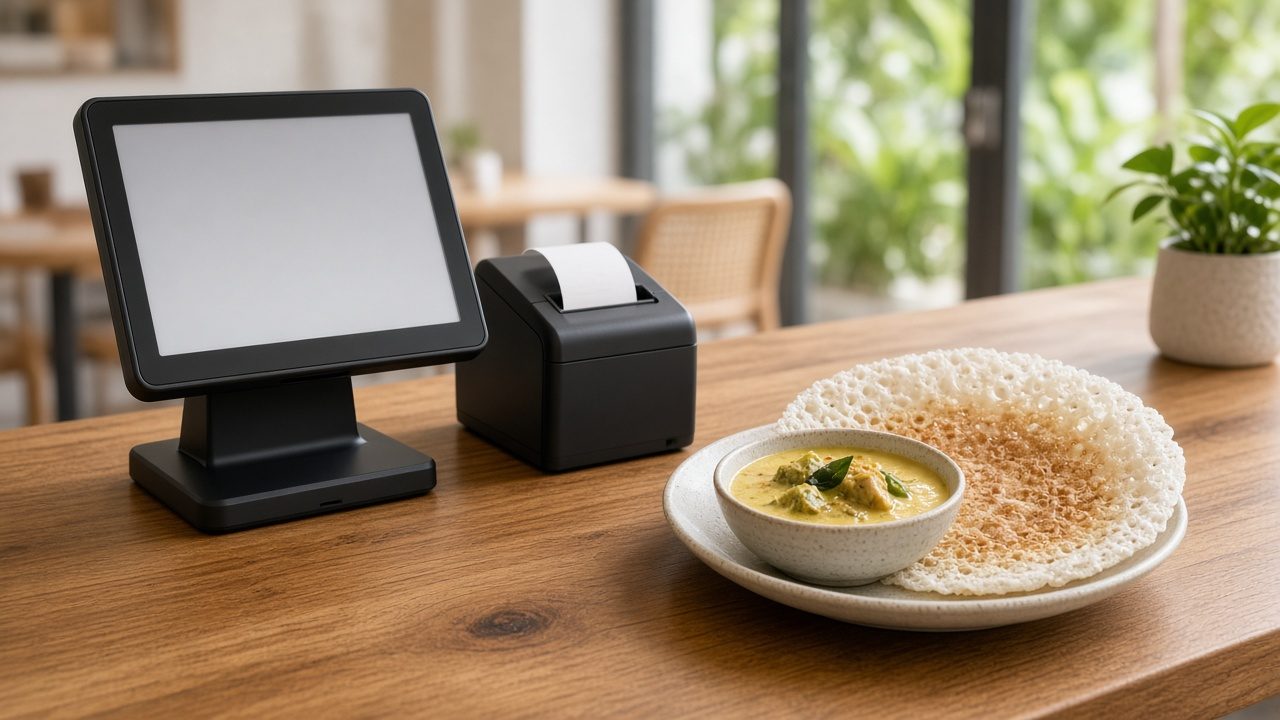
The easiest way to stay compliant on bills is to put the FSSAI number in the bill header of your billing software once, so it prints automatically on every invoice and KOT-linked bill. If you still write bills manually, read our guide to restaurant POS software in India to see how a POS handles headers, GST and table billing together.
Hygiene habits that make inspections easier
A licence does not protect a dirty kitchen. When a food safety officer visits, they look at the kitchen itself, not your paperwork alone. Habits that help:
- Keep raw and cooked food apart in the refrigerator, covered and labelled with the preparation date.
- Use stored ingredients on a first-expiry, first-out basis. Our note on FEFO vs FIFO explains when each method makes sense.
- Have a hand-wash station with soap near the cooking area, and keep pest control records.
- Send at least one supervisor for FSSAI’s FoSTaC food safety training, which licensed food service businesses are expected to have.
- Keep purchase bills for raw materials, so you can show where your oil, meat and dairy came from.
Clean records support the clean kitchen. When orders move from the table to the kitchen through printed KOTs instead of shouted orders, there is less waste and fewer disputes. If KOTs are new to you, see what a KOT is in a restaurant.
Common mistakes restaurant owners make
- Applying under the wrong category because only the cash counter sales were counted, leaving out delivery platform sales.
- Using one FSSAI number for two outlets or for a new address after shifting.
- Forgetting to modify the licence when partners change or a bakery or catering service is added.
- Not printing the number on bills, or printing an old number after moving to a State Licence.
- Paying an agent without checking the portal. Always log in to FoSCoS yourself and confirm the application status and fee receipt.
Put your FSSAI number on every bill automatically
Caddayn Biller lets you set your restaurant’s details, including the FSSAI number and GSTIN, in the bill format once, so every bill prints them correctly. It also handles KOTs, table billing, split bills, QR ordering, GST billing and UPI, card and cash payments, on Windows and on the web. Restaurants that need more can look at the Caddayn Restaurant ERP. You can download Caddayn Biller and set up your bill header before your next service.
FAQ
Which FSSAI licence does a small restaurant need?
From 1 April 2026, a restaurant with annual turnover up to Rs 1.5 crore needs FSSAI Basic Registration. Above Rs 1.5 crore and up to Rs 50 crore it needs a State Licence, and above Rs 50 crore a Central Licence.
How much does an FSSAI licence for a restaurant cost?
The government fee listed on FoSCoS for restaurants is Rs 100 a year for registration, Rs 5,000 for a State Licence and Rs 7,500 for a Central Licence. Consultant charges, if you use one, are extra.
Do I need to renew my FSSAI licence?
FSSAI approved perpetual validity for registrations and licences in March 2026, subject to inspections. Check your certificate and the FoSCoS dashboard, because the portal shows whether any renewal or modification is still pending for your number.
Is it compulsory to print the FSSAI number on restaurant bills?
Yes. FSSAI has directed food businesses to mention their FSSAI licence or registration number on bills, cash memos and invoices. Adding it to your billing software’s header is the simplest way to do this.
Can a cloud kitchen use the same FSSAI number as my restaurant?
Only if it runs from the same licensed premises and the food categories are covered. A separate kitchen at a different address needs its own registration or licence.
This article is general guidance, not legal advice. Rules and fees can change, so confirm the current position on the FSSAI website or with the Kerala food safety office before you apply.